2.2.4. FL Local Operations enabler
2.2.4.1. Introduction
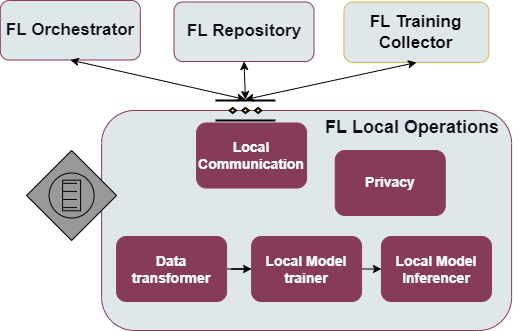
One of key goals of FL is to assure protection of privacy of data, owned by individual stakeholders. Therefore, data is expected to be used only locally, to train local version of the shared model, and only parameters update proposals of the ML algorithm are shared with others. When the FL training process has concluded, the final shared ML model is used to deliver specific functionality, also called inference engine. Both operations (model training and model inference) involve access to private data. This means that it is crucial to “encapsulate” local processes within a single “node” (that is controlled by data owner). However, it should be noticed that the data that is being used in both FL training processes has to be in the same format, which is imposed by the ML model that is being employed. In order to carry out with all these local operations, the FL Local Operation enabler is proposed. It consists of a few different modules: a data transformation module (the module handles the process of negotiating a suitable transformation pipeline for a given data format in order to allow for the training or inference of a specific model, and will be further extended in future works), a component encapsulated in a web application and responsible for model training, a component equipped with gRPC services and responsible for model inference, as well as a privacy module providing two selected privacy mechanisms for the FL training process (adaptive differential privacy and homomorphic encryption).
2.2.4.2. Features
Enabler embedded in each FL involved party performing local training.
The possibility of conducting such training using PyTorch and Keras libraries, additionally allowing for the detailed configuration of appropriate optimizers, schedulers and callbacks.
Verification of local data formats compatibility with data formats required by FL (This particular feature will still be expanded upon).
Transformation of local data formats to the format required by the ML system by specifying a chain of atomic transformations along with the appropriate parameters (this feature will, too, be expanded upon in the future versions).
Local storage of models for training process optimization purposes is allowed.
The local results are be sent to the FL Training Collector in order to carry out the appropriate aggregation methodology over the common shared model.
There are multiple aggregation algorithms provided, with an added possibility to implement and include an additional one.
The inference module allows for placing models in the TFLite format on inference. Combined with the inclusion of gRPC for inference module communication, it provides a particularly lightweight inference solution.
Communication of model updates via encryption mechanisms. Homomorphic encryption will not permit outsiders to see the output model of each device/party (MITM attacks), whereas methods for creating differentially private noise will guarantee that Malicious Aggregator cannot be allowed to infer which records are actual models and which not.
Unit tests are included which can be ran using
pytest.
2.2.4.3. Place in architecture
FL Local Operations enabler is one of the Federated Learning enablers that together enable to deploy a Federated Learning environment. Functionally, it operates on scalability and manageability verticals in the Assist-IoT architecture.
More specifically the following figure provides the semantic diagam of the enabler:
2.2.4.4. User guide
Interactions with this enabler are done through a REST API. In the FL environment the FL Orchestrator enabler sends appropriate configuration to FL Local Operations that later on communicate with FL Training Collector and FL Repository if required.
The enabler exposes REST API (see endpoints below) to communicate with external enablers/applications but also uses gRPC to communicate with FL Training Collector during model trainings.
Method |
Endpoint |
Description |
|---|---|---|
POST |
/job/config/{id} |
Receive configuration for a training job |
PUT |
/model/{id}/{version } |
Receive a new shared model |
GET |
/status |
Get current status of the enabler |
POST |
/job/transformer/{id } |
Receive any required data transformer for job with identifier id |
POST |
/predict/model/{id}/ {version} |
Inference with model |
2.2.4.5. Prerequisites
The main prerequisities are the installation of Docker and docker-compose. These prerequisites are necessary in case of running the enabler as a container (Docker). However, it is also possible to run the component independently. In this case, it’s mandatory to have Python installed on the machine where the enabler will be executed. At least version 3.8 is recommended (this is the version of the Python image being used). It is also necessary to install some additional libraries or packages. These additional packages can be seen in the requirements.txt file (inside the application folder).
2.2.4.6. Installation
The installation procedure for this enabler is under development and will be provided once the release of the enabler is completed.
2.2.4.7. Configuration options
The configuration of the training process for the FL Local Operations enabler is done with a request to REST API where the following parameters for a training job to be executed can be set:
client_type_id - type of client indicating what mechanisms are used in it, e.g. “keras1”
server_address - address of FL Training Collector, e.g. “training_collector”
eval_metrics - list of evaluation metrics, e.g. [“MSE”]
eval_func - evaluation function, e.g. “Huber”
eval_metrics_value - the baseline value of the metrics, e.g. 0
num_classes - number of classes, e.g. “10”
model_id - model identifier, e.g. “10”
model_version - model version, e.g. “10”
shape - shape of the data, e.g. [“32”, “32”, “3”]
training_id - the id of this specific training process
model_name - the name of the model to be loaded for the training
model_version - the version of the model to be loaded for the training
config - a dictionary specifying configuration values specific to this training process, like “batch_size” or “learning_rate”
optimizer_config - a dictionary specifying the type of the optimizer to be used, as well as parameter values specific to this optimizer
scheduler_config - a dictionary specifying the type of the scheduler to be used, as well as parameter values specific to this scheduler
warmup_config - a dictionary specifying the type of the warmup to be used, as well as parameter values specific to this warmup
privacy_mechanisms - a dictionary specifying whether the client should use privacy mechanisms and with what kind of parameters, with the possibility to select Homomorphic Encryption, Differential Privacy, none or both of them
2.2.4.8. Developer guide
2.2.4.8.1. Components
2.2.4.8.1.1. Local model trainer
The Local Model Training component is responsible for local model training. During configuration it instantiates appropriate ML training libraries and, if this is the beginning of the process, initial version of the shared model. This step can be completed locally by the node owner, but this is unlikely. The main priority lies in assuring uniformity of training methods across nodes belonging to different owner. The necessary modules (ML algorithm libraries and the initial version of the shared model) will be downloaded from the FL Repository.
2.2.4.8.1.2. Local model inferencer
The component is responsible for use of the trained model. Here, the model may be used: (1) after the FL process is completed, or (2) it may start to be used from a certain (predefined by the owner) level of quality of the shared model. In the latter case, each new version of the shared model would replace the previous one. Obviously, it is implicitly assumed that each new version of the shared global model will deliver better quality of results. Here, data to be fed into the trained model can be transformed using the Data Transformation Module. Interpretation of the results of application of the model to specific input data (including actions to be, possibly, undertaken on the basis of the results) is likely to be provided by the data owner. However, it is also possible that appropriate module is going to be downloaded from the FL Repository.
2.2.4.8.1.3. Local communication
Responsible for communication between external entities and the enabler.
2.2.4.8.1.4. Data transformer
In IoT ecosystems, each partner may (and is likely to) store data in its own (private/local) format. Use of FL requires transformation of appropriate parts of local data into the correct format. This format has to be described as part of the FL configuration, and all participating nodes have to oblige. This may be achieved by node owner providing a set of the appropriate transformation components, that applied in a certain order may allow for data format unification. However, such components have to be flexibly downloaded from the FL Repository enabler.
2.2.4.8.1.5. Privacy
The privacy capabilities of this module currently include two possible methods. The first, Homomorphic Encryption, relies on the implementation provided by the TenSEAL library to decrypt and encrypt the data as efficiently as possible. Unfortunately, due to the high memory usage of this encryption method, it can be used only for extremely small model architectures (such as Logistic Regression). Therefore, the encryption is included in the enabler only in its most basic form, with pregenerated secret files (which can nevertheless be later easily swapped and regenerated). Differential Privacy with adaptive clipping, on the other hand, is a method that can be applied in the training process regardless of the model size. A more detailed explanation of the functioning and modifiable parameters offered by the method can be found in: https://arxiv.org/pdf/1905.03871.pdf
2.2.4.8.2. Technologies
2.2.4.8.2.1. scikit-learn
A popular machine learning library often used for data preprocessing and transformation, for example encoding labels. It is open source and widely used in the industry.
2.2.4.8.2.2. pyTorch
An open source machine learning framework based on the Torch library, used for applications such as computer vision and natural language processing, primarily developed by Facebook’s AI Research lab (FAIR).
2.2.4.8.2.3. Python
Python is an interpreted high-level general-purpose programming language with a set of libraries. Very popular for data analysis and ML applications.
2.2.4.8.2.4. TensorFlow
A free and open-source software library for machine learning and artificial intelligence. It can be used across a range of tasks but has a particular focus on training and inference of deep neural networks.
2.2.4.8.2.4.1. Tensorflow Lite
A mobile library allowing for easy, lightweight deployment of ML models on mobile, microcontrollers and edge device. It employs, for example, quantization in order to decrease the resources consumed by the model during inference.
2.2.4.8.2.5. Flower
A federated learning framework designed to work with a large number of clients. It is both compatible with a variety of ML frameworks and supports a wide range of devices.
2.2.4.8.2.6. OpenCV
A real-time computer vision library providing already optimized models. It is cross-platform and open-source.
2.2.4.8.2.7. Pailier Encryption, Affine Homomorphic Encryption
A library that empowers users to easily conduct Homomorphic Encryption operations on tensors, built on top of Microsoft SEAL. Since the underlying implementation uses C++, the resulting methods consume as little resources as possible.
2.2.4.8.2.7.1. gRPC
A modern open source, high performance Remote Procedure Call (RPC) framework. gRPC works across many languages and platforms, is exceptionally efficient and scalable.
2.2.4.8.2.8. FastAPI
A popular web microframework written in Python, FastAPI is known for being both robust and high performing. It is based on OpenAPI (previously Swagger) standards.
2.2.4.9. Version control and release
Version control and release details will be provided in the next release of the documentation.
2.2.4.10. Licence
The FL Local Operations is licensed under the Apache License, Version2.0 (the “License”).
You may obtain a copy of the License at: http://www.apache.org/licenses/LICENSE-2.0
2.2.4.11. Notice (dependencies)
The information about the dependencies needed to run a specific part of
the application can be found described in the appropriate
requirements.txt files located. However, since they are downloaded
automatically during the construction of the appropriate Docker images,
the local dependencies needed to deploy the application include only a
local Docker along with Docker Compose or Kubernetes installation.