
1.2.7. WAN-Acceleration enabler
1.2.7.1. Introduction
The WAN acceleration enabler will incorporate features that will improve the connections among the clusters and/or sites managed by ASSIST-IoT, and towards the Internet. It will work jointly with the SD-WAN enabler to establish scalable, private tunnels and introduce optimisation features such as traffic prioritisation.
This enabler has reached a TRL of 5 during the execution of the ASSIST-IoT project.
1.2.7.2. Features
This enabler will be in charge of implementing features to support multiple WAN links, firewalling, tunnelling setups and traffic control, including traffic shaping. Depending on its configuration (via the SD-WAN enabler), it can act as:
An SD-WAN Edge component, present in each K8s cluster, with a dedicated K8s controller and a Containerised Network function (CNF) through which traffic goes through it. The CNF will embed functions to setup aspects such related to IPSec, firewalling, DNS, DHCP and WAN link management, whereas a Custom Definition Resource (CRD) controller contains all the sub-controllers to create, query and configure these features.
A SD-WAN hub, which will act as a middleware among clusters and/or between them and the Internet, enabling the introduction of additional CNFs related to security, filtering, traffic shaping, etc. Once the basic features are implemented, the incorporation of additional ones (as CNFs) will be evaluated.
1.2.7.3. Place in architecture
The WAN Acceleration enabler is located in the Smart Network and Control plane of the ASSIST-IoT architecture. In particular, it belongs to the building block related to VNFs, specifically (i) for provisioning private networks over public ones, jointly with the SD-WAN enabler, and (ii) for supporting VNFs chaining (containerised, thus CNFs).
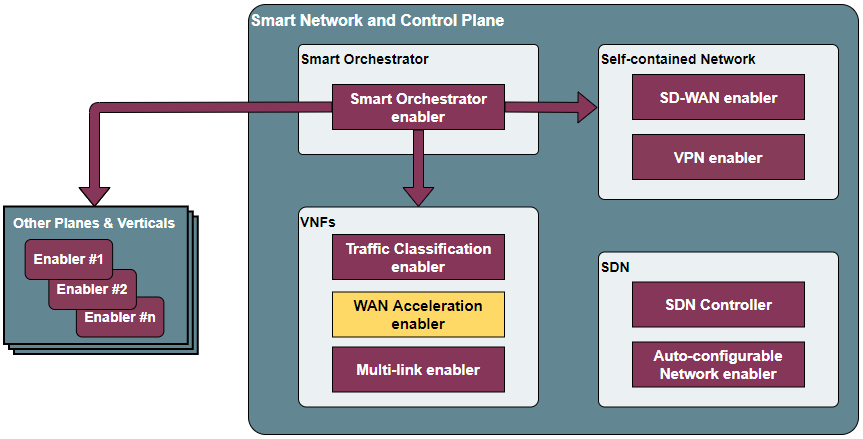
Place of the WAN Acceleration enabler within the Smart Network and Control Plance architecture
The following diagram aims at describing the global operation of the SD-WAN architecture, including the SD-WAN enabler and instances of the WAN Acceleration enabler (each of them composed by an SD-WAN custom k8s controller and an SD-WAN CNF).
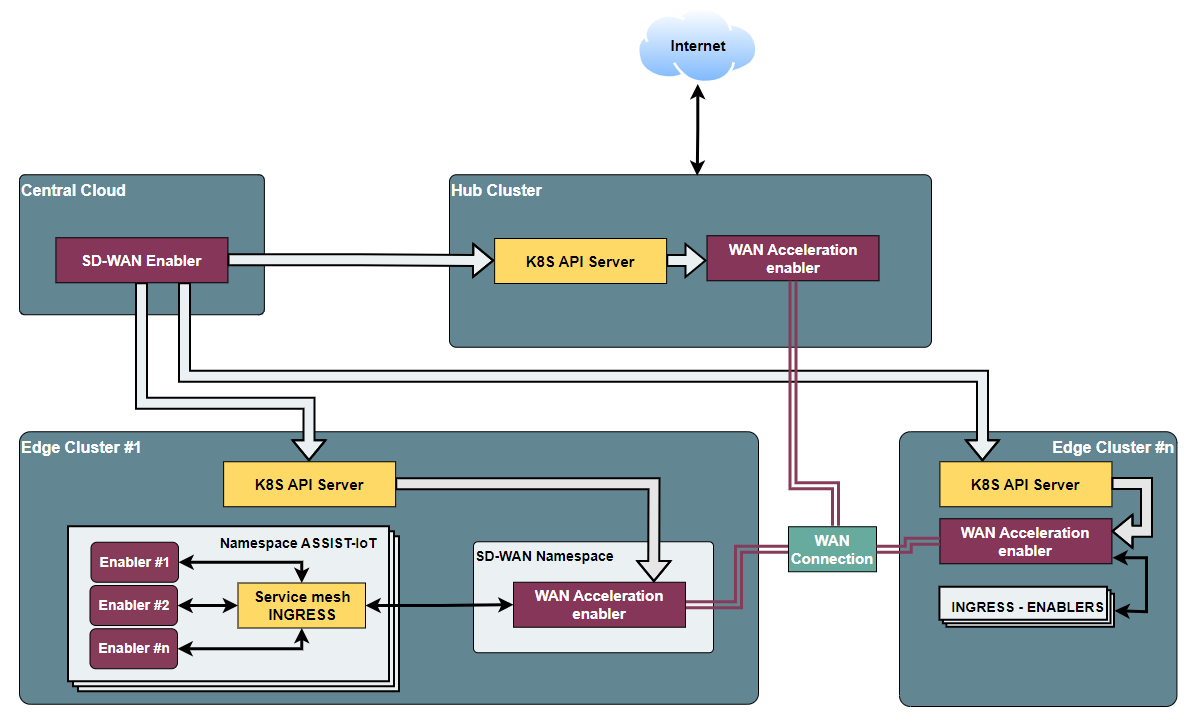
SD-WAN overall architecture
This overall SD-WAN architecture is guided by the following logic:
With the SD-WAN enabler, a user can define overlays, which are abstract groups of K8s clusters whose connections will be managed by the SD-WAN enabler.
Through this enabler, the user can define IPSec policies and IP ranges to later on establish tunnels among those clusters, which should have previously deployed an instance of the WAN acceleration enabler.
These clusters can act as edges or hubs. Hubs are particular instances of the WAN acceleration enabler that allow chaining network functions that will process the traffic among clusters and before navigating from/towards the Internet.
Besides, interacting with the K8s API (not directly with a WAN Acceleration’s CNF), a user can define firewall, wan and traffic optimisation policies in the edge clusters.
As aforementioned, the enabler is composed of three main elements, as one can see in the figure below:
CRD Controller: Component that will receive API calls from the K8s API of the cluster to configure the CNF component.
SD-WAN CNF: The CNF will embed functions to setup aspects such related to IPSec, firewalling, DNS, DHCP and WAN link management, exposing an API to be controlled/queried.
API: The API component contains an easy-to-use interface to create, list or delete all configuration related to internal management, such as firewall rules or mwan3 policies. This component interacts directly with the K8S API server rather than with other components.

WAN Acceleration enabler architecture
1.2.7.4. User guide
In the following table are presented the endpoint ready to use:
1.2.7.4.1. Firewall
Define internal firewall configuration. This functionality uses groups to manage general behavior and can define rules, access permissions and source, forward or destination NAT rules.
Zones
Method |
Endpoint |
Description |
Payload (if need) |
|---|---|---|---|
POST |
api/v1/firewall/zones |
Zone Registration |
{“metadata”: {“name”: “ovn-network”},”spec”: {“network”: [“ovn-network”]}} |
GET |
api/v1/firewall/zones |
Get all firewall zones |
|
GET |
api/v1/firewall/zones/{zone-name} |
Get firewall zone by name |
|
DELETE |
api/v1/firewall/zones/{zone-name} |
Delete firewall zone |
SNAT
Method |
Endpoint |
Description |
Payload (if need) |
|---|---|---|---|
POST |
api/v1/firewall/snats |
SNAT Registration |
{“metadata”: {“name”: “firewallsnat”},”spec”: {“src”: “ovn-network”}} |
GET |
api/v1/firewall/snats |
Get all firewall snats |
|
GET |
api/v1/firewall/snats/{snat-name} |
Get firewall snat by name |
|
DELETE |
api/v1/firewall/snats/{snat-name} |
Delete firewall snat |
DNAT
Method |
Endpoint |
Description |
Payload (if need) |
|---|---|---|---|
POST |
api/v1/firewall/dnats |
DNAT Registration |
{“metadata”: {“name”: “firewalldnat”},”spec”: {“src”: “pnetwork”}} |
GET |
api/v1/firewall/dnats |
Get all firewall dnats |
|
GET |
api/v1/firewall/dnats/{dnat-name} |
Get firewall dnat by name |
|
DELETE |
api/v1/firewall/dnats/{dnat-name} |
Delete firewall dnat |
Forwarding
Method |
Endpoint |
Description |
Payload (if need) |
|---|---|---|---|
POST |
api/v1/firewall/forwardings |
Forwarding Registration |
{“metadata”: {“name”: “firewallforwarding”},”spec”: {“src”: “ovn-network”}} |
GET |
api/v1/firewall/forwardings |
Get all firewall forwardings |
|
GET |
api/v1/firewall/forwardings/{forwarding-name} |
Get firewall forwarding by name |
|
DELETE |
api/v1/firewall/forwardings/{forwarding-name} |
Delete firewall forwarding |
Rules
Method |
Endpoint |
Description |
Payload (if need) |
|---|---|---|---|
POST |
api/v1/firewall/rules |
Firewall Rule Registration |
{“metadata”: {“name”: “firewallrule”},”spec”: {“src”: “ovn-network”}} |
GET |
api/v1/firewall/rules |
Get all firewall rules |
|
GET |
api/v1/firewall/rules/{rule-name} |
Get firewall rule by name |
|
DELETE |
api/v1/firewall/ruless/{rule-name} |
Delete firewall rule |
1.2.7.4.2. MWAN3
Define internal mwan3 configuration. Define policies and rules to manage balancing and failover for each edge cluster.
Policies
Method |
Endpoint |
Description |
Payload (if need) |
|---|---|---|---|
POST |
api/v1/mwan3/policies |
MWAN3 Policy Registration |
{“metadata”: {“name”: “mwan3policy”},”spec”: {“members”}} |
GET |
api/v1/mwan3/policies |
Get all mwan3 policies |
|
GET |
api/v1/mwan3/policies/{policy-name} |
Get mwan3 policy by name |
|
DELETE |
api/v1/mwan3/policies/{policy-name} |
Delete firewall policy |
Rules
### Rules |
|||
|---|---|---|---|
Method |
Endpoint |
Description |
Payload (if need) |
POST |
api/v1/mwan3/rules |
MWAN3 Rule Registration |
{“metadata”: {“name”: “mwan3rule”},”spec”: {“family”}} |
GET |
api/v1/mwan3/rules |
Get all mwan3 rules |
|
GET |
api/v1/mwan3/rules/{rule-name} |
Get mwan3 rule by name |
|
DELETE |
api/v1/mwan3/rules/{rule-name} |
Delete firewall rule |
1.2.7.5. Prerequisites
In this case, the enabler required some CNI plugins for K8s:
Calico.
Multus daemonset.
OVN daemonset.
OVN networks.
Cert manager to manage connection between networks.
In addition, the enabler will require provisioning the kubeconfig files of the clusters to manage and information about the involved certificates.
1.2.7.6. Installation
Prerrequisites are available to install in shell bash script named “kubernetes.sh”. Rest of installation are done implemented by k8s manifests. In future releases, the installation will be by helm charts.
Steps of installation are avaible in gitlab repository.
1.2.7.7. Configuration options
An analysis of the configurations to be modifiable by a user is under assessment. The exposed port for accessing the API will be one of the available options.
1.2.7.8. Developer guide
This code is expected to be executed within a Helm chart, in a Kubernetes-governed platform. It has been also tested with Docker compose and directly over Ubuntu x64 distributions, with and without GPU NVIDIA processors. In case that developers aims at using the code directly over a given Operating System, non-virtualized, the code has been tested only in Ubuntu 20.04 machines, and hence we do not grant that it will work in any other OS.
This code is open source and can be freely used by the innovation and research community. In case that commits are to be made, the mantainer team (UPV) holds the rights to accept or deny them. Best practices are encouraged in the latter case.
1.2.7.9. Version control and release
Version 1.0.0
1.2.7.10. License
This software is licensed under the Apache 2.0 license.
1.2.7.11. Notice (dependencies)
ASSIST-IoT - Architecture for Scalable, Self-*, human-centric, Intelligent, Se-cure, and Tactile next generation IoT
This project has received funding from the European Union’s Horizon 2020 research and innovation programme under grant agreement No 957258.
WAN-Acceleration enabler
Copyright 2020-2023 Universitat Politècnica de València
Included Software
icn-sdwan (https://github.com/akraino-edge-stack/icn-sdwan), Apache-2.0 license
Used Software
click 8.0.3 (https://github.com/pallets/click/tree/8.0.x), BSD-3-Clause li-cense
colorama 0.4.4 (https://github.com/tartley/colorama/tree/0.4.4), BSD-3-Clause license
Flask 2.0.2 (https://github.com/pallets/flask/tree/2.0.x), BSD-3-Clause li-cense
itsdangerous 2.0.1 (https://github.com/pallets/itsdangerous/tree/2.0.1) BSD-3-Clause license
Jinja2 3.0.3 (https://github.com/pallets/jinja/tree/3.0.3), BSD-3-Clause license
MarkupSafe 2.0.1 (https://github.com/pallets/markupsafe/tree/2.0.1), BSD-3-Clause license
Werkzeug 2.0.2 (https://github.com/pallets/werkzeug/tree/2.0.x), BSD-3-Clause license
gunicorn 20.1.0 (https://github.com/benoitc/gunicorn/tree/20.x), custom li-cense (see list below)
requests 2.27.1 (https://github.com/psf/requests/tree/v2.27.x), Apache-2.0 license
flask_wtf 1.0.0 (https://github.com/wtforms/flask-wtf/tree/1.0.x), BSD-3-Clause license
peewee 3.14.10 (https://github.com/coleifer/peewee/tree/3.14.10), MIT license
wtforms (https://github.com/wtforms/wtforms), BSD-3-Clause license
kubernetes (https://github.com/kubernetes-client/python), Apache-2.0 license
pint (https://github.com/hgrecco/pint/tree/master), BSD-3-Clause li-cense
pymsql (https://github.com/PyMySQL/PyMySQL), MIT licens
List of licenses
BSD-3-Clause license (https://opensource.org/license/bsd-3-clause/)
Gunicorn license (https://github.com/benoitc/gunicorn/blob/master/LICENSE)
Apache-2.0 license (https://www.apache.org/licenses/LICENSE-2.0)
MIT license (https://opensource.org/license/mit/)