1.2.4. Traffic classification enabler
1.2.4.1. Introduction
In SDN-enabled networks, a controller is responsible for controlling the underlying switches that distribute traffic according to different rules, including sources/sinks, ports and type of traffic. The aim of this enabler is aid the controller to classify network traffic into a number of application classes (video streaming, VoIP, Network control, best effort, OAM, etc.), making use of an AI/ML framework and dedicated algo-rithms. The traffic classification enabler can be seen as a service of the application layer of the general SDN architecture.
1.2.4.2. Features
Two main features are supported by this enabler, especifically:
Training a machine learning model to classify traffic packets, based on the combination of different algorithms.
To inference the type of traffic of a specific packet based on different packet parameters.
To that end, the enabler will rely on a Deep Neural Network (DNN) which combines the outputs of three models, hence being a “meta-model”. The underlying classifers are based on K-Nearest Neighbours (KNN), Random Forest (RF), and Decision Tree (DT) algorithms.
Note
At this moment, only the expossed API only works for classifying a packet, not for (re)training the model.
1.2.4.3. Place in architecture
The VPN enabler is located in the Smart Network and Control plane of the ASSIST-IoT architecture. In particular, it will be one of the enablers devoted to improve the performance of the network, in this case acting as an application that aids the SDN controller.
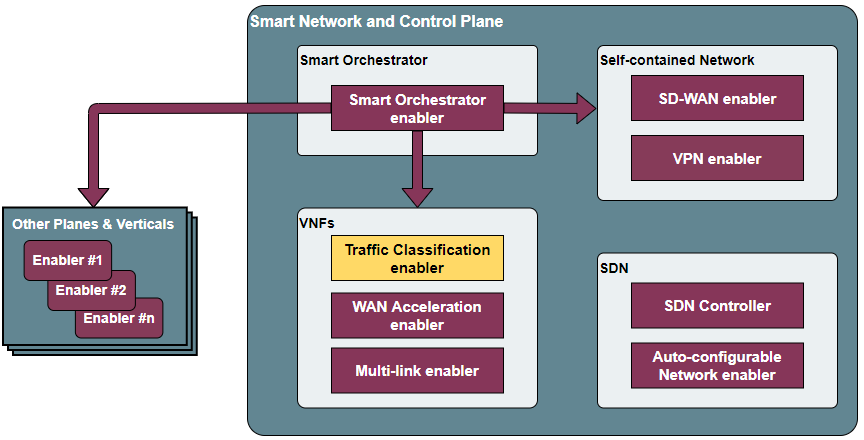
Place of the Traffic Classification enabler within the Smart Network and Control Plance architecture
The enabler is composed of three main elements, as one can see in the figure below:
Traffic Classification API: an API REST will act as a central proxy of the operations that are offered by the enabler. It is responsible of managing the API calls related to starting an inference (i.e., traffic classification) process and retrain the AI model with new data.
Training Module: It will be invoked for training the DNN model and sub-models by the user, ideally when an extended or new dataset is available.
Classifier: It will contain the functions in charge of executing the inference process, taking a trained model and a set of packet features as inputs.

Traffic Classification enabler architecture
1.2.4.4. User guide
1.2.4.4.1. REST API endpoints
The API has not been finalised yet, in the following table are presented the endpoints that will be implemented.
Method |
Endpoint |
Description |
Payload (if needed) |
Response format |
|---|---|---|---|---|
POST |
/training |
Get information of the WireGuard network interface |
Successful or error code depending on the result |
|
POST |
/inference |
Returns the class of a specific packet, based on the inputs received and the application of the DNN model. |
JSON with the output class |
Currently, to classify a packet to get its class, a request has to be made to the IP address of the host and the corresponding port of the service (4000 by default). The request has to be accompanied by a body with a set of parameters belonging to the packet to be classified (extracted from .pcap files). A request example is attached below (e.g., protocol = 1 corresponds to ICMP protocol):
curl --location --request POST 'http://<IP_address>:<api_port>/v1' -d
{
  "protocol": "1",
  "src_port": "0",
  "dst_port": "0",
  "src2dst_packets": "16",
  "src2dst_bytes": "5332",
  "dst2src_packets": "8",
  "dst2src_bytes": "612"
}
The request for performing the request has not been implemented yet.
1.2.4.5. Prerequisites
The current version works in a Docker environment with Docker Compose, they must be installed previously.
1.2.4.6. Installation
Any Helm chart nor dedicated K8s manifest has been developed yet. Two steps are needed before using the enabler:
Build the docker image:
docker build -t networkclassifier .Run the docker container:
docker run -p 4000:4000 -d networkclassifier
1.2.4.7. Configuration options
Only one configuration variable of the enabler can be configured right now. To set it up, the Docker compose file has to be modified manually. In the future, this variable will be managed by Helm’s values.yaml manifest.
API_PORT: Port where the Traffic Classification API is exposed.
1.2.4.8. Developer guide
Will be determined after the release of the enabler.
1.2.4.9. Version control and release
Version 0.1. A major release has not been released yet as some key functionalities are missing and it is not ready for being deployed in K8s environments.
1.2.4.10. License
Apache License 2.0.
This work is extends the research presented in P.K. Mondal et.al, “A dynamic network traffic classifier using supervised ML for a Docker-based SDN network”, 2021, Connection Science, 1-26.
1.2.4.11. Notice (dependencies)
This enabler does not depend on any other. However, it provides an additional functionality for the SDN Controller, being interesting to be deployed together (integration between them still pending).